How Haiti’s leaders protected themselves from prosecution.
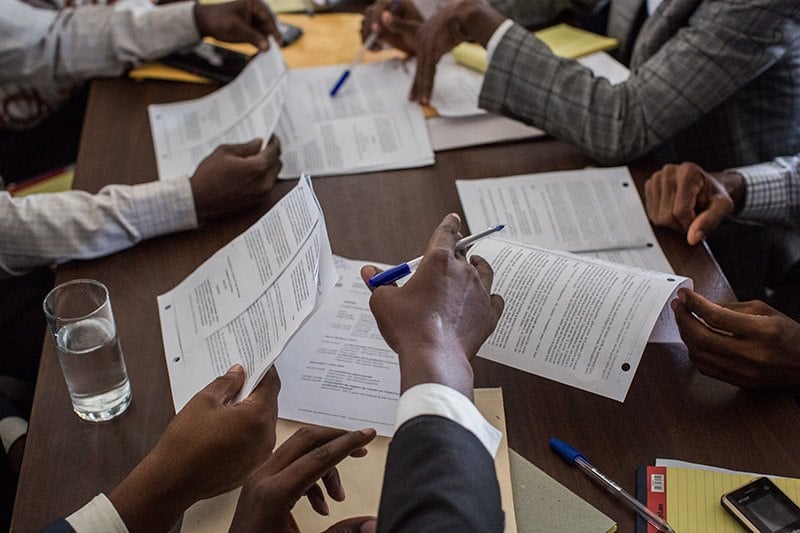
Two years ago, a corruption scandal rocked Haiti’s new transition government. Three members of the presidential council met with the director of a state-owned bank and allegedly asked him to pay them almost $800,000 if he wanted to keep his job.
A government anti-corruption agency investigated and recommended criminal prosecution of the three council members, along with the bank director, who had allegedly begun paying the bribe by issuing them personal credit cards with no expectation of repayment.
An investigating judge summoned the three leaders—but they refused to appear. Instead, they challenged the summons, arguing that their presidential authority granted them constitutional immunity. Eventually, an appeals court ruled that they were protected while in government—but crucially, they could face prosecution after they left office.
Before the end of their term, those same three men—Smith Augustin, Emmanuel Vertilaire, and Louis Gérald Gilles—signed two decrees. One creates a highly politicized and currently unworkable court that has jurisdiction over any top official—current or former—accused of committing any crime while in office. The second curtails the ability of journalists and advocates to publicly discuss allegations of officials’ wrongdoing.
Instead of moving Haiti closer to holding powerful officials accountable for any crimes they have committed, the two decrees move accountability further out of reach. They risk undermining every recent effort to fight corruption and gang-linked criminality—efforts that are essential to restoring government functioning and public security. They should be revoked.
The first decree says that if top public officials commit a crime while in office, they cannot be tried by an ordinary court and must be tried before a yet-unformed High Court of Justice. The High Court would require a vote from the Chamber of Deputies to launch a case and would operate within the Senate. Today, the mechanism cannot function at all: Haiti has no sitting Chamber of Deputies and no Senate.
Even after parliament returns, a case would have to survive three separate two-thirds votes before an official could be convicted. The High Court would not be able to sentence anyone to prison—its only penalties would be removal from office and/or a temporary prohibition on holding office. But a High Court conviction would be required before a top official could face prosecution in an ordinary court. So a former prime minister accused of a crime years after leaving office would first have to be convicted through this complex political process before facing ordinary criminal justice.
The decree also blocks anti-corruption investigations from ever leading to criminal prosecution. It says that before a report on corruption can even reach the High Court, it must clear a series of political approvals—from the anti-corruption agency’s governing board, Haiti’s cabinet, the justice minister, a 20-member parliamentary commission, and finally a two-thirds vote of the Chamber of Deputies. Any one of them could stop a case from advancing.
It is an astonishingly brazen document; not only do the decree’s signatories include the three presidential council members named in the bank corruption scandal, but they signed in December, a few months before the February dissolution of the presidential council that would have otherwise exposed them to prosecution for corruption in criminal court.
Haiti’s 1987 Constitution envisioned a High Court of Justice to hear accusations against sitting presidents, prime ministers, cabinet ministers, and certain senior judicial officials for misconduct in office. This decree expands its reach.
Instead of focusing narrowly on sitting officials accused of misconduct while exercising their duties, it extends the High Court’s jurisdiction to current and past senior officials accused of any crime committed while they held high offices. It explicitly bars other courts from hearing those cases—making a conviction in the High Court the mandatory first step to open even the possibility of a criminal case. Essentially, it provides Haiti’s top leaders with a lifelong shield for crimes they committed while they held power.
This change comes exactly at the moment when Haiti is attempting to create specialized courts to prosecute corruption and gang sponsorship among the most powerful Haitians—precisely because the regular courts have been unable to bring them to justice.
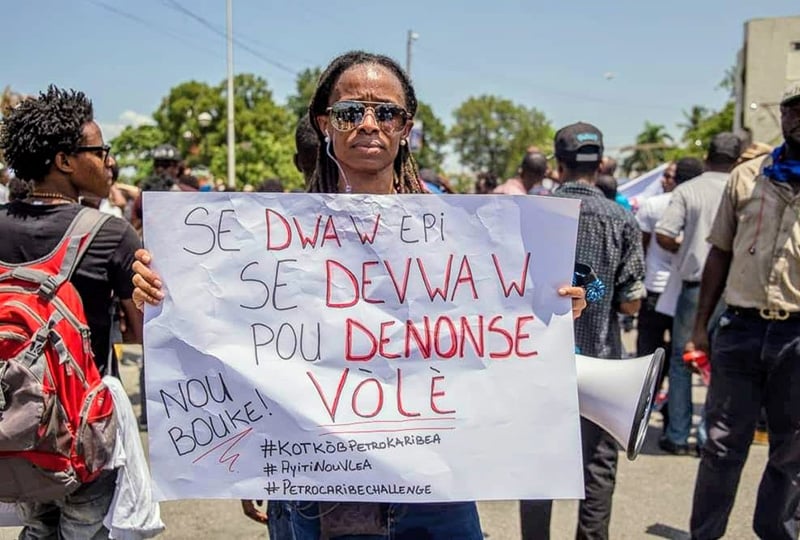
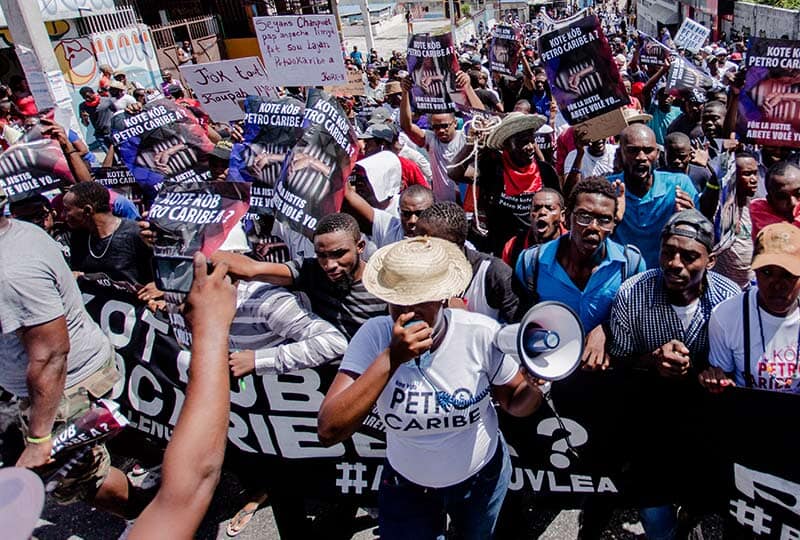
There was a long line of leaders many Haitians hoped would finally face justice in these new courts: a former president, several former prime ministers, and dozens of former cabinet ministers implicated in the massive PetroCaribe corruption scandal—including some later sanctioned by the United States and Canada for corruption and gang sponsorship. Most have suffered no consequences for their actions, and many continue to wield political influence.
This new decree does not simply delay justice for them—it makes it nearly impossible for them to ever face consequences.
The decree drew criticism from Haitian civil society leaders as well as international officials. Antoine Michon, then the French ambassador to Haiti, warned that it amounted to “an institutionalization of impunity for all past, present, and future political leaders.”
The second decree, on defamation, also published in December, functions in tandem with the first. If senior officials cannot be prosecuted, who can expose their corruption? Civil society organizations like ours, which investigate and report on official wrongdoing; and the Haitian media, which reports on our findings. The defamation decree threatens both.
It stipulates severe penalties for defamation, insulting officials, and spreading false news—harsh fines and up to three years in prison. A person could be charged with defamation for harming someone’s reputation, even if their allegation is true. The “insult” charge is not defined, and here, too, truth is not a defense. For spreading false news, it’s not clear how falsity would be determined. Together, these provisions give authorities a powerful tool to suppress public discussion of official wrongdoing.
The lawfulness of these decrees should be adjudicated by a Constitutional court—but Haiti doesn’t have one.
The question of how to treat onetime high-level officials who committed crimes while in office was settled by Haitian legislators more than a century ago. On June 27, 1904, Haiti’s parliament adopted a law that said that former senior state officials may be prosecuted in ordinary courts without any special authorization from the legislative branch. That law remains in force.
Haiti has a modern test of this principle. When former President Jean-Claude Duvalier returned to Haiti in 2011, some 25 years after his ouster, an ordinary court prosecuted him for corruption and crimes against humanity. His lawyers did not argue that his onetime position as head of state should place him beyond the reach of the usual justice system. No one attempted to convene the High Court of Justice.
For years, the U.S. has sanctioned Haitian officials to attempt to bring justice to the people who have helped create Haiti’s crisis through their corruption and gang sponsorship. These sanctions can isolate people, freeze their assets, or restrict their travel—but they do not necessarily limit their ability to continue illicit activities, or even, potentially, return to politics.
Only the Haitian state can impose real justice.
Without a Constitutional court to rule on the illegality of the new laws, there is only the court of public opinion—and the defamation decree threatens that, too.
That’s why I’m saying here: The prime minister must revoke these decrees.
So far, Prime Minister Alix Didier Fils-Aimé seems committed to defending them. He fired the head of an independent state anti-corruption agency, Hans Ludwig Joseph, who had held the post since 2020, after Joseph gave a private briefing to the UN Security Council analyzing the potential impact of the High Court decree.
The United States and other countries are investing heavily in a security force and a political transition intended to restore Haiti’s stability. International officials should ask whether their policies are strengthening accountability or helping accommodate the very dynamics that continue to fuel Haiti’s crisis.
Neither Haiti nor its international partners should expect to establish lasting security while political leaders linked to corruption, gang sponsorship, and abuse of power remain shielded from consequences.
 Rosy Auguste Ducéna is the program director of the National Human Rights Defense Network in Haiti.