But there are ways to break free.
Today in Haiti, much of government operates on the currency of corruption.
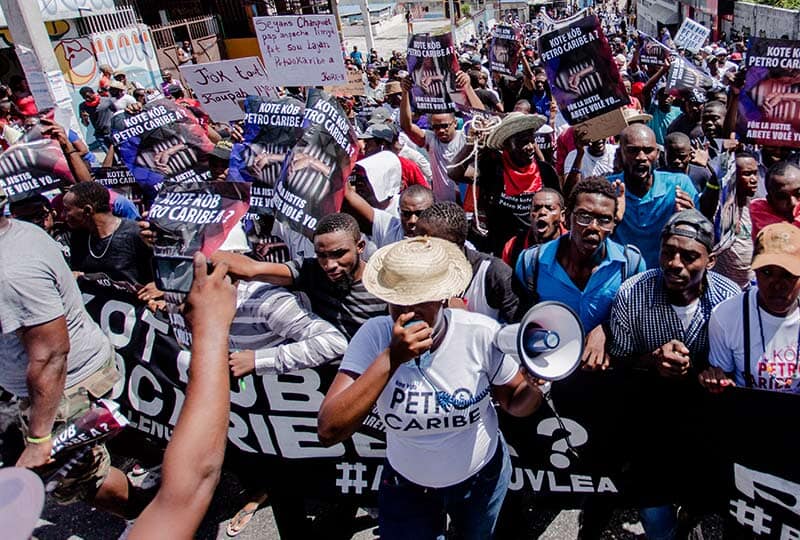
While there are people of integrity in all state agencies, networks of corrupt politicians, bureaucrats, and private businesspeople collude to shape decrees, institutions, and processes, and share public resources among themselves.
Seeking to fend off investigations and prosecutions, corruption networks have eaten away at the efficacy of the justice system to the point where it is essentially impotent to prosecute them. And they have instrumentalized gangs to target popular resistance, elevating gang power.
Haiti wasn’t always this way—and it doesn’t need to be now.
Haitian institutions and civil society organizations—including our group, Together Against Corruption—are working to confront corruption, push for institutional reforms, and rebuild tools of accountability within the state. We believe that current levels of corruption are sustained by existing structures that we can change.
While we are advancing concrete reforms, we need sustained international backing to support our efforts at institutional change.
In this piece, I will explain how we are working to fix the problem. I will show how deeply things have gone wrong over the past decade and a half—and how we can get back on track.
The route to state capture
Like many countries, Haiti has wrestled with forms of corruption for generations. Under the Duvalier dictatorship, the ruling family used the state as a personal ATM. After the regime fell, institutions—especially the judiciary—remained weak. Low salaries and opaque state agencies further facilitated corruption.
But today, corruption is structurally different—it fuels government policies, hobbles the state’s functioning, and paralyzes the country.
The earthquake in Haiti in 2010 shook our country in many ways, including by creating optimal conditions for corruption. First, it brought foreign aid on a new scale, with little tracking of how funds were spent or whether they delivered results. Then a highly contested election brought President Michel Martelly, who installed patronage networks at every level of the civil service, including people linked with corruption, drug and arms trafficking, and gangs. As state wealth evaporated over the following decade, there was almost no accountability.
Martelly’s successor, President Jovenel Moïse, relied on gang violence—including civilian massacres— to suppress anti-corruption protests. He refused to prosecute corrupt officials, and appointed allies of his political party, Parti Haïtien Tèt Kale (PHTK), as municipal leaders. By the time Moïse was assassinated in 2021, PHTK had installed officials throughout the civil service—some of whom have since been linked to corruption, drug and arms trafficking, and gang massacres.
How corruption protects itself from attack
Today, corrupt people covet government jobs not for their potential to serve the people—but for their access to state resources. Officials surround themselves with networks of loyalists who help distribute benefits and block investigations.
For years, the international community has sanctioned corrupt individuals while backing their potentially complicit colleagues and funding and legitimizing the institutions they shaped .
Two main state institutions track corruption: the Central Financial Intelligence Unit (UCREF), established in 2001 to investigate money laundering and financial crimes, and the Anti-Corruption Unit (ULCC), created in 2004 to investigate corruption in public agencies.
But Haiti’s leaders have tried to weaken these institutions. In early 2017, UCREF produced an investigative report that implicated President-Elect Jovenel Moïse in corruption. When he assumed the presidency, Moïse changed the appointment process for the head of the UCREF to give the executive branch direct control over the selection and he replaced the heads of UCREF and ULCC with political allies.
More recently, the ULCC published charges of bribery against three members of the Transitional Presidential Council (CPT) that governed until February. The council iss ued a decree preventing the unit from sending cases directly to prosecutors and sought to replace the leadership of the anti-corruption agencies. The CPT and the current prime minister, Alix Didier Fils-Aimé, also issued two decrees that consolidate impunity for corruption, which we are now working to overturn. The first requires current and former high-level government officials accused of corruption to be tried by a High Court of Justice that does not currently exist—making it practically impossible to prosecute top government officials.
The second increases penalties for defamation without recognizing truth as a defense. It imposes particularly severe legal consequences, including prison terms, for statements that harm officials’ reputations—putting anti-corruption advocates and civil society groups at risk of prosecution.
These efforts have not gone uncontested: Haitian civil society groups continue to publicly challenge both of these decrees.
Let’s look at how corruption works in Haiti today.
Public contracts: a core mechanism
Public contracts are a primary vehicle for officials to enrich themselves and reward their friends. Contracts for roads, ports, fuel, electricity, customs, sanitation, and even basic services such as catering and cleaning are routinely awarded without competition, at inflated prices, to companies created to capture public funds. If the good or service is delivered at all, it is often substandard.
For example, in July 2024, the Haitian National Police issued a tender to award 11 contracts to supply food for police units. Eight of the winning companies—together awarded contracts worth nearly US $23 million—raised immediate red flags. Four had consecutive tax identification numbers issued by the same office on the same day, making it likely that they were actually created by one person and all part of one entity. When Together Against Corruption visited the addresses of the kitchens where the companies proposed to make food, six did not exist.
An investigative commission established by the Ministry of Justice after an appeal from Together Against Corruption recommended ending all the contracts and pursuing possible prosecution. But the Haitian investigative outlet AyiboPost reported that only two of the companies were stopped from carrying out their contracts—the others proceeded.
Customs and Taxation
Customs, historically one of Haiti’s main sources of public revenue, has become a principal source of private enrichment. Illicit cash payments at ports help fuel an informal parallel economy that makes up more than half of the country’s GDP—where taxes are rarely collected and where it is difficult to track financial crimes.
United Nations reports have documented the rise of a corrupt Customs system under PHTK leadership. Businessman Reynold Deeb, who was allegedly close with Martelly, reportedly helped select Customs officials at key ports of entry. Romel Bell, who eventually became Customs director, reportedly diverted revenue and “abetted criminal activities” within the agency. Figures like PHTK Senator Rony Célestin reportedly paid officials and gangs to avoid customs fees and protect his imports of construction materials. These people have since been sanctioned by either Canada or the U.S.—but without prosecuting them and investigating their networks, their systems may remain intact. Arms and ammunition still enter ports with little inspection, fueling gang power.
The tax authority is similarly compromised. A 2025 report by the International Monetary Fund identified fraud, weak monitoring, and even a lack of basic accounting for revenues. In a 2021 survey by Together Against Corruption, nearly three-quarters of Haitians who had interacted with the tax authority reported paying bribes. Government revenue remains around five percent of GDP—among the lowest globally—severely limiting state capacity.
Justice
The justice system rarely functions in corruption cases—-not because of a lack of legal expertise, but because of political pressure, intimidation, and chronic under-resourcing.
Of 166 reports of corruption the ULCC and UCREF transmitted to the courts from 2006 to 2024, only four resulted in a conviction, my organization found. Some 97 percent of cases went nowhere in the justice system.
When Together Against Corruption published a report suggesting massive corruption in the Ministry of Sports, for instance (alleging the minister used an institutional bank card for personal expenses; checks were cashed for deceased employees; contractors’ payments disappeared; the ministry’s fuel budget doubled while actual fuel allocations decreased; and many other instances of misconduct), and the ULCC followed up on the claims, there were no subsequent judicial investigations or prosecutions—and at the time this article was published, Sports Minister Niola Lynn Sarah Devalien Octavius retained her post.
Executive interference is blatant. Often, judges, prosecutors, and clerks are bribed to ignore or disappear a case.
Elections
The consequences of unchecked corruption are especially ominous as we approach the planned elections. Gang leaders remain at large, controlling vast territories of the capital and country, which will compromise voting—and they are also likely to channel the funds they have gained through illicit means into the campaigns of candidates who collaborate with them, risking the emergence of gangs as a major political force. Without safeguards, we could see gang-beholden candidates win the presidency, as well as a majority of seats in parliament, and the mayoralties of the country’s largest cities.
To prevent this, Together Against Corruption is calling for the creation of a task force including investigators from the ULCC and UCREF, as well as representatives of the electoral council, and technical experts designated by civil society to monitor the campaign financing of all candidates.
Even outside of the concern about gangs, it is difficult to hold clean elections with the current levels of corruption alongside structural aids for it. A law passed under the Martelly administration reduced the threshold to form a political party to as few as 20 signatures, and also introduced government funding for campaigns. This created incentives for people to form political parties for personal gain, while the electoral law fails to give the electoral council the tools or capacity to vet candidates, including those with criminal ties. The CPT allocated 3 billion gourdes—more than US $20 million—for campaigns for political parties for the elections planned for 2026, allowing hundreds of loosely defined organizations to access public funds with minimal oversight. A record 320 parties registered in March to participate in upcoming elections.
Corruption as a daily reality
Corruption shapes politics and business and trickles down to the life of every Haitian: Citizens pay bribes to acquire driver’s licenses, birth certificates, passports; they pay bribes to nurses and doctors and teachers. Together Against Corruption found that in Artibonite and the Center, 100 percent of 2021 survey respondents reported having paid a bribe to access services in the previous year.
That doesn’t mean that corruption is too pervasive to fight. It means that we need urgent support for institutional reform that can make a difference.
What we can do
Corruption in Haiti is not inevitable—but the result of political and institutional choices. Corruption can be curbed through deliberate reforms we are already advancing. We know this works because we see small successes every day—corruption exposed, boondoggles abandoned, corrupt officials fired, watchdog agencies supported.
Haitians must continue to investigate and document corruption, and educate and mobilize people against it. But the international community has a critical role, too.
Restoring the efficacy of Haiti’s institutions requires the international community to do more than just sanction a handful of corrupt officials. It requires funders to invest in Haitian civil society efforts to rebuild state institutions, the justice system, and public accountability—so that decisions are made transparently, enforced consistently, and subject to oversight, and so that violators of the law are brought to justice. It requires advocates and policymakers to center anti-corruption and accountability measures when developing strategies for security.
The international community should support six immediate structural measures Haitian civil society groups are fighting to advance. Each of these proposals we have developed works to loosen the vice grip corruption holds on public life:
- Establish a genuinely independent specialized court to investigate and prosecute financial crimes. A court subordinated to existing political structures, such as the one the CPT recently established by decree, will fail.
- Digitize and physically secure court records so corruption cases cannot disappear.
- Move public services online to limit possibilities for Haitian officials to demand bribes.
- Support the passage of the access-to-information law so the public can scrutinize corruption investigations and state contracts.
- Support the overturning of the two recent decrees on defamation and on prosecuting officials charged with crimes.
- Support the creation of a task force including representatives of ULCC, UCREF, the electoral council, and technical experts, with input from civil society, to monitor campaign financing for the upcoming elections.
Without these structural changes, elections will not restore legitimacy. Aid will not stabilize the country. Security operations will not defeat gangs. Any strategy that ignores corruption will reinforce and extend Haiti’s crisis.
This crisis of corruption and impunity is not a failure of Haitian society or civic capacity, but the result of sustained political decisions that can, and must, be reversed.
 Edouard Paultre is the executive secretary of Ensemble Contre La Corruption, Together Against Corruption, which fights structural corruption in Haiti and seeks to rebuild accountability tools.