Our movement showed that bringing justice is critical for Haiti’s security and stability.
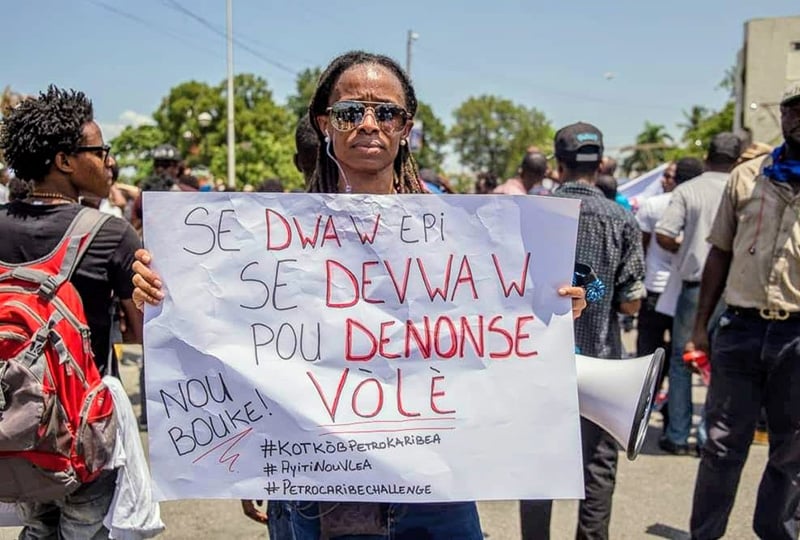
One day back in August 2018, I saw a picture of an acquaintance on social media. He was blindfolded and holding up a cardboard sign that said: “Where is the PetroCaribe money?”
Where is the money?
The Venezuelan government had backed an oil loan program, known as PetroCaribe, that would offer Haiti funds to invest in infrastructure and programs for the poor. Our leaders had promised us so much—roads, education, healthcare, electricity, agricultural aid, reforestation; a new and better country. I had believed in that.
But a decade after the program started in 2008, little had materialized. Anyone could see that food silos had not been built, solar lamps had not been installed, hospitals had not been expanded. We began to realize that our leaders had stolen and squandered public funds on a scale never before seen in Haiti.
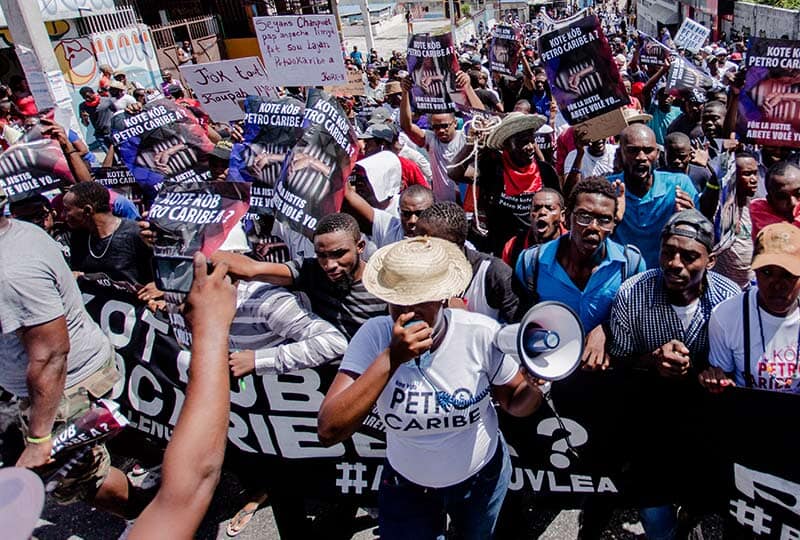
As the question of what happened to the money blazed through social media, people called for a demonstration, which became many demonstrations, which became a popular movement. Haitians demanded the government audit the misspending and name those responsible.
We expected that corrupt leaders would be ousted and prosecuted, their networks dismantled. We thought our movement would lay ground for a new, functional state. –But none of that happened.
Instead, Haitian officials powerfully resisted mass demands, as the people implicated in the misspending, including many of the country’s top leaders, largely held onto their positions—and their income streams.
There are likely still beneficiaries of PetroCaribe corruption in the government today. We don’t know how many or who: Higher-level officials were never held accountable and their networks were left untouched; lower-level officials were never even named.
It’s important for the international community to understand this so that today, foreign policy can effectively target corruption and impunity and produce real solutions for Haiti.
Officials’ efforts to resist accountability and maintain their power are at the core of Haiti’s political and security crises today.
Corrupt officials don’t make policy to restore security, improve government, or serve the people—they make policy to maximize their profits and protect their networks and their positions. They install coconspirators who can shape laws, allocate one another contracts, and close ranks to pressure judicial officials. This is how corruption can paralyze the state.
Our rotten government cannot right itself without combined pressure from Haitian civil society and the international community. That is what Haiti needs now.
A spark that ignited a movement
Prior to our movement’s rise, the Haitian Senate had quietly published two reports on the misuse of the PetroCaribe funds. The Court of Auditors had investigated the malfeasance, but had stalled on releasing its potentially incendiary report. We wanted those names.
I could see all around me what had been stolen from Haiti. The electricity was always out, and there was little basic maintenance for anything, including the clogged ravines that channel drainage—or, just as often, sewage overflow—from the hills down through Port-au-Prince. Hospitals had so few supplies that when people came in to get stitches, they had to pay for their own needle and thread.
When a sit-in was planned at the Court of Auditors, I took the day off work to attend. Many people came in shirts and ties, on breaks from jobs as lawyers, teachers, and doctors.
Then we took matters into our own hands and launched a “collective audit.” Across Haiti, people went to sites where politicians had given speeches and erected billboards advertising the marvels they would build. People posted photos showing a puddle-filled dirt road where a paved one had been promised; skeletal concrete frames where there should have been a hospital; an empty field where there was supposed to be new housing.
Soon we held protests almost every Sunday.
We thought that if we could only get enough people to the streets, we could get the Court of Auditors to release the report so the corrupt leaders could face justice. In any functioning democracy, this kind of protest demands accountability and protects government integrity.
The government strikes back
But on October 17 2018, as people turned out in multiple cities to attend one of the largest peaceful demonstrations in Haiti’s history, police shot live rounds at protesters. Many were injured and two people died.
We pressed on to plan an even bigger demonstration in November. Some of our most dedicated activists were from La Saline, a poor neighborhood and opposition stronghold in Port-au-Prince.
On November 13, armed gang members showed up in La Saline. Some wore police uniforms and commanded residents to come out of their houses—only to execute them in the streets. In an act of true horror, they killed at least 71 people, including adults, children, and a baby.
Witnesses later said that top government officials had coordinated the massacre, supplying the killers with weapons and vehicles. We got the message: accept corruption or die.
We marched anyway, as planned, on November 18. I will always remember seeing hundreds of people walking uphill from La Saline to join us, grief-stricken but resolute.
That day, I also saw snipers in camouflage on rooftops. People were shot—one man, in the head.
It became clear that not only was much of our government corrupt, but top officials were willing to wage war against us to protect their corruption.
The PetroCaribe reports emerge—to nothing
We held a sit-in over several days and nights outside the Court of Auditors, with the slogan, “Nou Pap Dòmi,” We Will Not Sleep. The words stuck as a name for our collective: We are awake and watching.
Eventually, the court released three reports detailing how high officials had stolen and squandered a staggering $2 billion. The second report singled out then-President Jovenel Moïse, saying his company had been part of an embezzlement scheme prior to his presidency.
The reports documented the looting of the state on an industrial scale: massive overbilling, ghost projects, contracts awarded to politically connected but ineffective firms—all resulting in projects that were poorly executed or never realized at all. This went far beyond the scale of the petty corruption that had long been a feature of Haitian public life. This was a gross, systematic violation of the Haitian people by the Haitian state.
Somehow, I had still imagined that the government would launch criminal proceedings against those named in the reports. In functioning democracies, leaders elected by the people are responsible to them—they want to be reelected or want their party to keep power. But our leaders didn’t feel they needed to answer for their actions at all. And our institutions were not able to enforce their accountability.
Using violence to stop justice
Instead, as the reports came out, Haiti came apart.
After issuing the first report, judges at the Court of Auditors said they received constant death threats pressuring them to abort further reporting—several fled the country.
We received threats, too. People approached us at the supermarket to tell us our advocacy could get us killed. Some of us were fired. Our kids were not invited to birthday parties.
I lost my job in April 2019, and as I searched for work, I lost count of how often I was told that my political views made me unemployable. Though I’m among the most qualified people in my field in Haiti, it took me almost three years to find a new job. I felt as though I was radioactive; old friends didn’t want to be seen with me for fear of repercussions from their own associates close to the regime.
Hundreds of our activists lost government contracts, partnerships, patients, clients, endorsements.
Many Haitians supported the international community’s sanctions against corrupt Haitian officials. If these leaders were outed internationally, many thought, the Haitian justice system would be forced to prosecute them.
Sanctions from Canada and the U.S. hit two recent Haitian presidents, three prime ministers, and a dozen assorted cabinet ministers, senators, and members of parliament.
But the threats against people around me seemed only to increase. In a devastating blow, my friend, the journalist Antoinette “Netty” Duclaire, who had protested alongside us, was assassinated with journalist Diego Charles.
Several of our activists received threats so severe, they fled the country.
We held two sit-ins in front of the Ministry of Justice that were violently repressed while the minister was inside—and then we stopped organizing protests. After so many profound losses, we could no longer justify calling people to the streets to risk their lives.
Corrupt officials may still hold power
Today, the rot remains. The officials sanctioned by Canada and U.S. faced few consequences. Many still live in Haiti in lavish homes bought with our stolen money. Others are abroad, living with total impunity. Their networks remain untouched. They can work in prominent jobs.
You would expect the Haitian government to immediately open investigations into the sanctioned ex-presidents and ex-prime ministers implicated in criminality. But there has been only a single attempt, when the state anti-corruption agency belatedly opened an investigation into former President Michel Martelly in October 2024. Despite the naming of dozens of senior officials involved in the PetroCaribe scandal, no one has been prosecuted at all.
Haitian leaders cannot fix our security crisis or return us to a democratic path while they are also enmeshed in corruption networks. We have not carried out the vetting or the judicial proceedings needed to remove those engaged with criminality from power.
Instead, in municipalities across Haiti, they may well be the very officials gearing up to plan the next elections.
Our movement showed that Haitians can mobilize oversight, challenge the political order, and force the state to respond. We helped uncover corruption on a vast scale—and also revealed a deeper breakdown in governance. Haitian institutions were too weak, captured or intimidated to translate truth into accountability.
What the international community can do
I wish we could simply start over, with a fresh government made up of people of integrity who are not affiliated with corrupt political parties. I wish our judiciary could immediately function to deliver justice. I wish the international community would stop enabling our oppressors.
But the international community can right now help carve out corruption-free oases of clean operating that move the whole country toward better practices.
I have seen in the corporate world in Haiti that clear expectations and consequences can force companies to rise to meet international norms of reporting, transparency, and accountability.
Foreign countries, international organizations, and donors that engage with the Haitian government and civil society organizations can impose these same standards of accountability—with consequences for failure—wherever they touch.
The U.S. and other countries should make clear that they will not support the transitional government or state agencies that fail to vet and audit themselves effectively, that fail to deliver measurable results, whose accounts suggest irregularities, or whose officials are credibly accused of corruption or other criminal activity.
Countries supporting Haiti should establish expectations for investigating any corruption charges on specific timelines and potentially removing implicated officials. Consequences for failing to abide by these protocols should include pausing financial support and ending programs.
Donors can operate similarly. When they fund projects in Haiti—including with the government—they can demand audited reporting, oversight, and mechanisms to end funding if standards are not maintained. It is that simple: Impose consequences.
Current international sanctions are often toothless; they, too, should carry consequences, in the form of follow-up prosecutions. The U.S., Canada, and UN should provide evidence and technical support to the Haitian judiciary to effectively bring claims against sanctioned Haitians. The U.S., Canada, France, and other countries should help our judiciary bring cases by conducting their own criminal prosecutions of Haitian officials who break international laws.
International pressure is most effective when it strengthens the organizations and institutions capable of enforcing accountability over time. The goal is not only to punish corrupt officials, but to help rebuild the governance and accountability structures that prevent corruption from reproducing itself.
Lessons not yet learned
Haiti did not fall apart by chance. We exposed corruption, but without prosecutions, the truth only made the corrupt government violently defensive. Our leaders instrumentalized gangs to silence the population, and the state collapsed.
Now, everyone is talking about how to end Haiti’s crisis.
Looking at Haiti’s past decade and a half, it is clear what went wrong and how to fix it: Impose justice on corrupt officials and remove them from politics, civil service, and public life. Insist on oversight, transparency, and good government. End impunity.
The PetroCaribe movement proved that Haitians are willing and able to expose and confront abuses; what failed was not civic capacity, but institutions of accountability.
 Vélina Élysée Charlier is a founding member of Nou Pap Dòmi.