
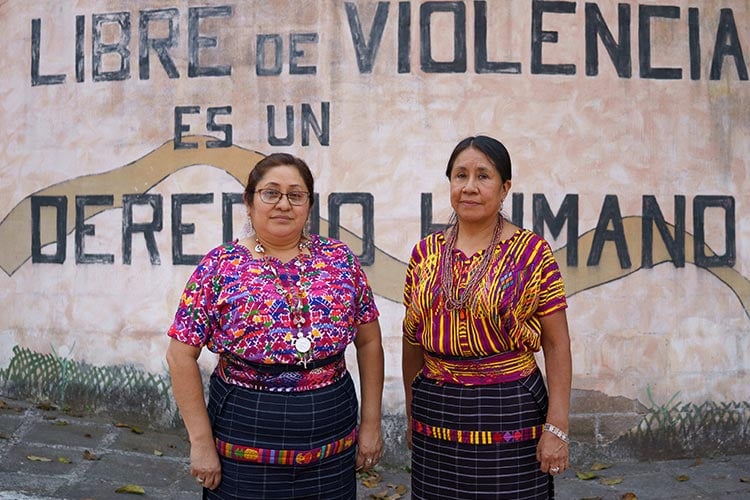
From an early age, Carmela Curup Chajon and Olivia Sienchavez knew that the Guatemala they grew up in would not be the Guatemala they left behind.
Today, from a small, unassuming office in Guatemala City, these women fight relentlessly for justice for Indigenous communities in court, leading AJWS grantee organization Bufete para Pueblas Indígenas (BPI), or the Indigenous Law Firm. Their devotion comes from shared, deeply personal struggles. Carmela and Olivia, and the rest of BPI’s team, are Indigenous themselves. On any given day, they are involved in about 100 legal cases — all with no charge to their clients. But they are not just representing clients — they are fighting for the human rights and dignity of all 24 Indigenous groups in Guatemala.
The Indigenous Peoples of Guatemala have been systematically oppressed for centuries — first by Spanish colonizers, and then by the ruling class of Ladinos (or Spanish-descendants), who made up the vast majority of the country’s landowners. This oppression exploded into violence during Guatemala’s 36-year internal armed conflict, where the military murdered and disappeared over 250,000 rural and Indigenous Guatemalans.
Today, three decades after the end of the conflict, this oppression persists in a new form — Indigenous communities are regularly dispossessed of their ancestral lands and watch industries callously pollute their water. When they speak out, Indigenous Peoples are often ‘criminalized,’ or arrested under falsified charges with no legal merit. The entire legal apparatus that BPI works within is stacked against them — but that’s not enough to stop Carmela, Olivia and their team. They believe they carry the torch of generations of Indigenous Guatemalans who never had the tools that they now possess — law degrees.
“Our ancestors have lived through more than 500 years of exploitation and injustice. So what right do I have to throw up my hands and say ‘I’m done’? The only thing we have is hope,” says 50-year-old Olivia. “There is simply no other choice.”
Both Olivia and Carmela grew up near San Juan Sacatepequez in central Guatemala. Carmela remembers when her “political consciousness was born,” during the country’s long, brutal conflict.
“We’d hear marimba music on the radio, then a new voice announcing that the government had been overthrown. One corrupt group would take power from another corrupt group,” says 60-year-old Carmela. “But none of them represented Indigenous Peoples. And as I grew up, I understood the commonality of racist aggression, no matter who was in charge of the country.”
A decade apart, Olivia and Carmela both defied the strict gender norms for women and graduated high school, going to on study law — a rarity for Guatemalan women, let alone Indigenous women.
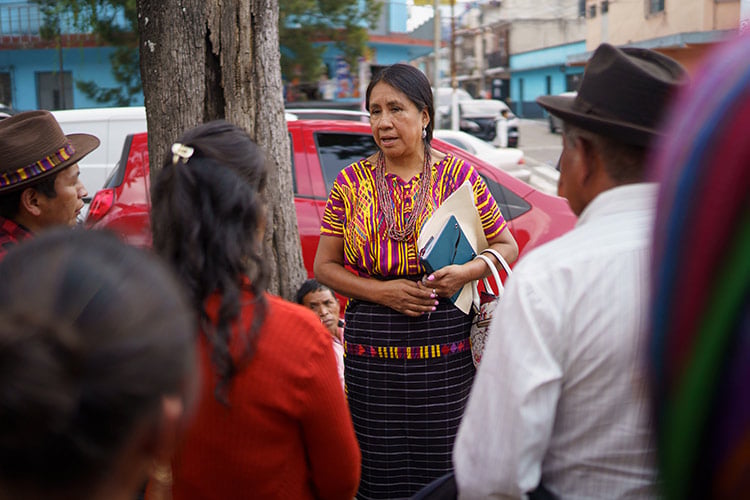
“Non-Maya students would look at me and ask: Do you want to come work at my house? They’d see my traditional clothing and assume all we’re good for is housework,” remembers Olivia. “For Indigenous Peoples, injustice isn’t just a single, eye-opening moment. We’re born into a perpetual state of injustice.”
Still, they persevered. Carmela became the first Indigenous woman lawyer in San Juan Sacatepequez; Olivia was the second. They began to realize that by working together and devoting themselves to Indigenous justice, they could have an impact extending far beyond their clients.
Carmela founded BPI in 2018, and Olivia joined a few years later. BPI works closely with a network of AJWS partners across Guatemala to support communities under threat from palm oil and other extractive industries. In the last few years, BPI has won cases leading to the legal return of about 350 square miles of land to Indigenous Peoples, and the release of several detained Indigenous leaders. They are currently working on a class action lawsuit filed with the Inter-American Commission for Human Rights, representing Qana’ch’och’’, an AJWS-supported grassroots movement of communities whose water has been polluted by the palm oil industry.
Even today, as some of the most accomplished lawyers in the country, the BPI team faces the same discrimination from their childhood — a reminder that Guatemalan society still determines their worth based on their ethnicity. But they will never stop fighting for change.
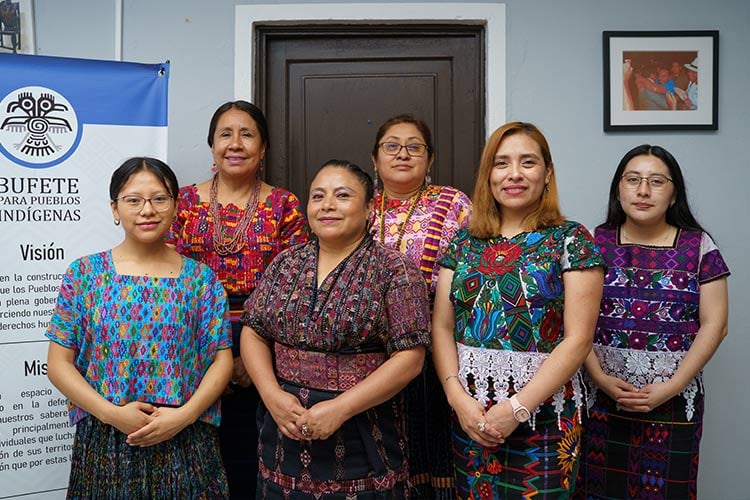
“When I arrive at the courthouse, they never think I’m the lawyer. They think I’m a victim, and they’ll catcall me to make me feel small,” says Olivia. “Then I show them my ID, and I watch the smirk drop off their faces.”
For Carmela, becoming the spearhead of a national Indigenous rights movement — along with a whole network of AJWS grantee organizations — has only fanned the fire she’s always felt.
“In Guatemala, Indigenous organizations all stand together in the face of the same forces that have oppressed us for generations. But the more these adversaries see that we’re in alliance, that we’re strong, that we’re not backing down, the more they understand that they can’t persecute us forever,” she says. “We make up half the country, and they’ll need to treat us with dignity.”