

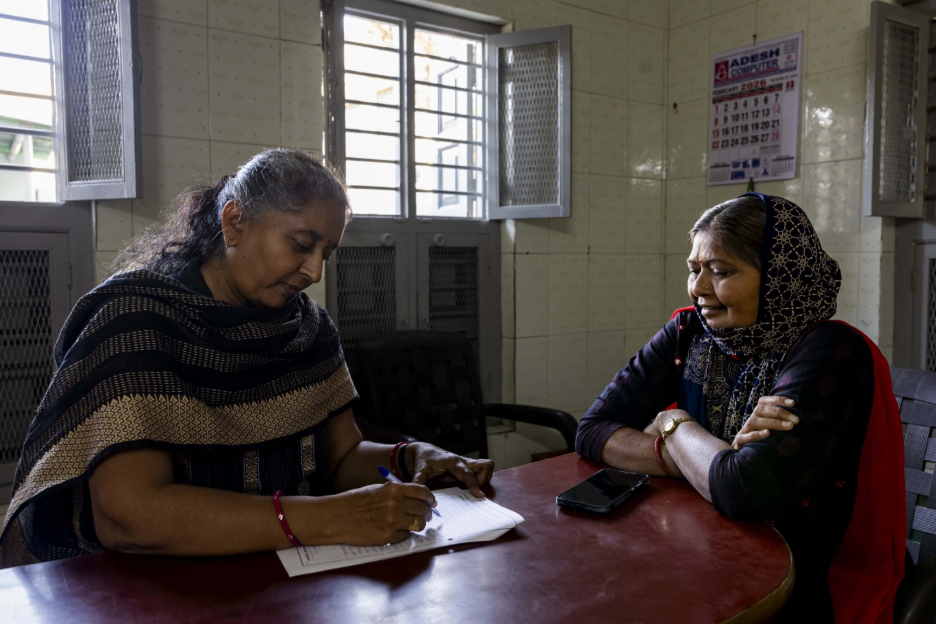
“Indian patriarchy is very, very deep rooted and nurtured from birth: You shall not question men. It’s entwined into the smallest moments of daily life,” says Aruna Dholakiya, program leader of AJWS partner organization Kutch Mahila Vikas Sangathan (KMVS). “Girls internalize these patriarchal beliefs; the patriarchy becomes them.”
Across India, AJWS supports grassroots organizations like KMVS to help women unlearn these patriarchal beliefs and take control of their lives—halting child marriages, restarting their educations and pursuing careers. But these deeply-ingrained beliefs can surface dramatically in moments of crisis—including during episodes of domestic violence—pushing women to remain silent.
That’s why KMVS launched Hello Sakhi—an initiative to help women who’ve survived domestic violence through each stage of healing. It begins, of course, with first reaching out for help; Hello Sakhi runs a helpline for women in crisis. Hello Sakhi staff then guide survivors along a path towards justice, whether that means couples mediation, filing charges or filing for divorce. To date, Hello Sakhi has supported more than 10,000 women.
One of the women, 49-year-old Nirmala ben Mukesh Bhai Chavda, a teacher from the coastal city of Mandvi in the state of Gujarat, was married at 19 and quickly gave birth to two daughters.
“I was lucky; my husband gave me more freedom than I expected in a marriage,” she says now. “He never interfered in my studies and I felt free to speak my mind. I knew this was unique. I felt I had a blessed life.”
But as her daughters grew, Nimala’s husband began gambling, then drinking; she felt her blessings crumble.
“The first time he hit me, I was shocked,” she remembers. “Who was this man? Where did my husband go, the man who raised our daughters, who built a life with me?”
When her husband strangled her in front of her daughters, Nirmala realized she needed to defend herself—and that she’d internalized patriarchal beliefs for too long. A friend connected her to Hello Sakhi, and she made a call that changed her life.
KMVS launched Hello Sakhi in 2010; today, the helpline fields about 130 calls a month.
“First, we need to ensure a woman’s mental health is taken care—we help her step out of an emergency state,” says Khatija Samija, Hello Sakhi’s Project Coordinator. “After she’s cried out her tears, we get to work. The key question is: what does she want to do. Justice looks different for different women.”
If a woman is in danger, Hello Sakhi arranges a temporary shelter. In most cases, says Khatija, “she doesn’t want to abandon her household. But she also knows this violence can’t continue.”
Some women wish to file police reports but are intimidated by stories of police harassment or mockery; Hello Sakhi staff accompany them without hesitation. KMVS has trained hundreds of women across Gujarat as paralegals, forming an army of volunteers ready to help those in need.
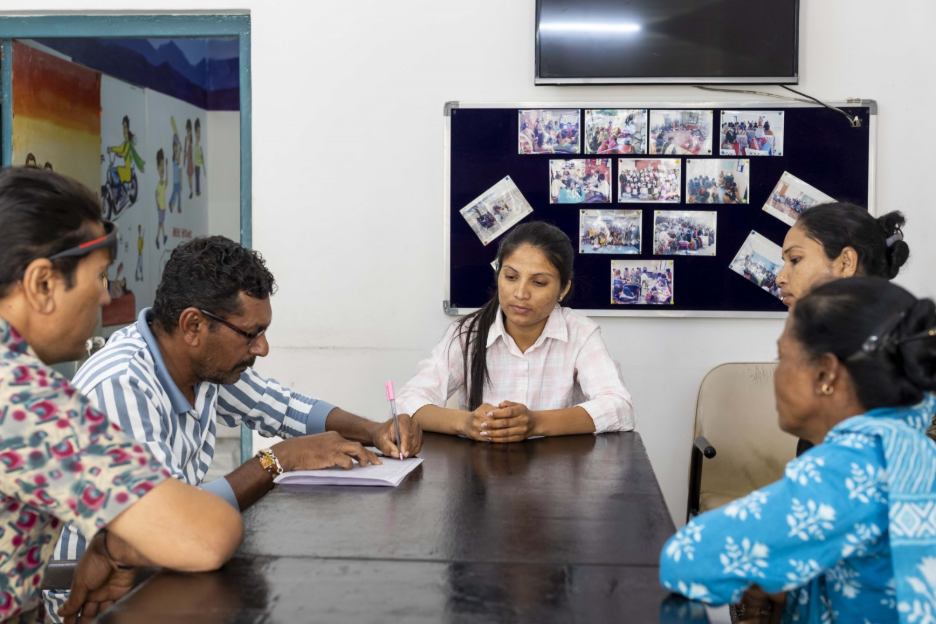
“Women reach out to us with a lot of hope,” says Hello Sakhi helpline operator Bhagyasha Jhala. “We have to meet that hope with action.”
For Nirmala, finally being heard was a major relief when she called Hello Sakhi.
“Hello Sakhi is for women, by women,” she says. “The women who call are terrified of going to the police, overwhelmed by the courts, intimidated to speak up. But the staff understand us—as Indian women, they know what we are facing. And this gives us the strength to carry on.”
Nirmala met with her local Hello Sakhi coordinator and together they devised a plan of action. Slowly, Nirmala and her husband entered mediation; he agreed to stop drinking entirely. She also sought, and was awarded, compensation through the courts to ensure that he continued to support her and their family. Amazingly, Nirmala and her husband did not ultimately separate—thanks to ongoing support from Hello Sakhi, Nirmala says her marriage is back on track.
“I have found peace, mentally,” says Nirmala. “And I have found justice. Hello Sakhi solved the most painful problem in my life.”