
On a recent afternoon in Bangalore, India, almost 100 people pack the auditorium of the city’s National Gallery of Modern Art. For over an hour, they witness something extraordinarily rare: eight middle-aged queer and trans people talking about their lives and dreams, their families and friends. It’s a professional performance complete with music, lights, sets, and costumes that’s incredibly intimate, like sitting in a friend’s living room and catching up.
For generations, queer and trans people in India have been pushed into the shadows, oppressed, stigmatized, and marginalized. But this revolutionary theater troupe is bringing their stories back into the spotlight.
Welcome to “Talki”—a play produced and performed by AJWS grantee organization Payana. Over the past year, they’ve performed “Talki” more than 40 times across the country, in museums, universities, and theater festivals.
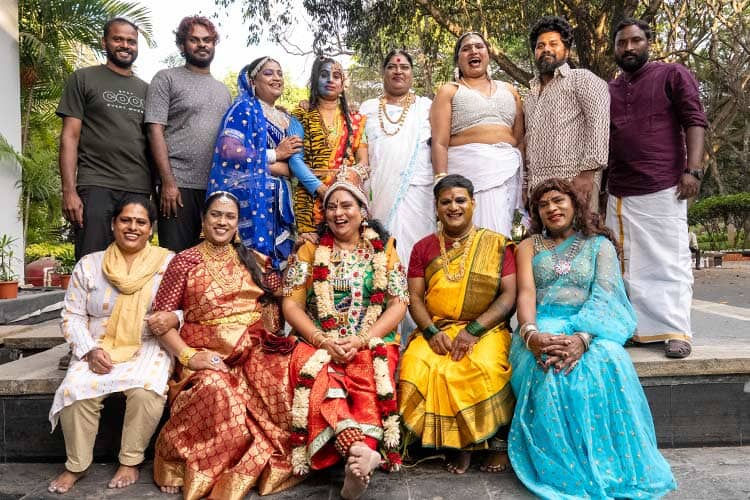
“Talki” addresses a complex problem in a simple way.
“There is growing division in India among religion, caste, and especially sexual orientation and gender identity; our right-wing politicians try to sow fear to rule us,” says “Talki” director Srijith Sundaram. “The only way we can fight this division is through art, literature, and theater. These stories are what unite us. They exhibit our shared humanity.”
“Talki” is Payana’s latest initiative to build a more equal and open India, where LGBTQI+ people can live with dignity, safety, and freedom. Since it was founded in 2009, Payana has been fighting for LGBTQI+ rights in Bangalore and beyond, while creating a huge support system that includes about 45,000 people.
Payana helps more than 2,000 transgender women access healthcare and offers free HIV prevention and testing. Payana’s work also focuses outward—engaging Indians to think critically about their fear towards the LGBTQI+ community, slowly but surely chipping away at a culture of persecution and violence.
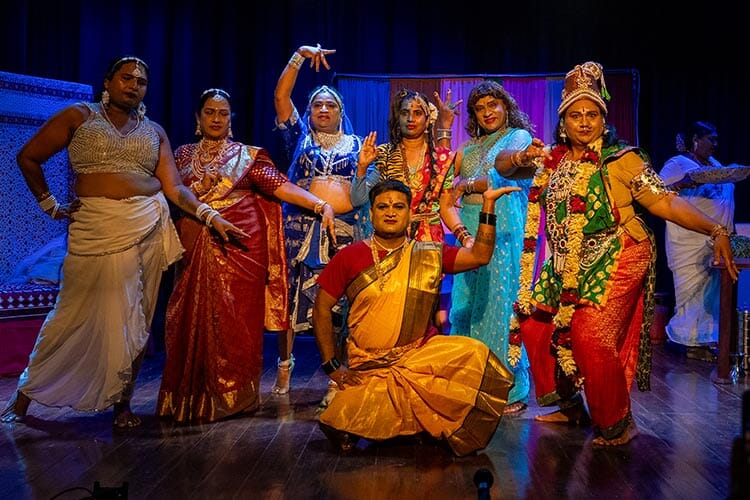
“Talki” began as a photoshoot. Srijith, a multi-disciplinary artist, asked Payana community members about their childhood dreams—how they saw themselves before their families or communities chastised them for their queerness. He then photographed them dressed as those visions: a movie star, a diva, a female Hindu deity. Each of the eight community members then wrote out their own stories of self-discovery; these stories became monologues; they crafted dialogue between them, and “Talki” was born.
“Indian society is defined by division: caste, color, religion, gender, sexuality. But ‘Talki’ breaks down this idea that we must all be identified—we are all just human beings with dreams, stories, emotions. We stop focusing on our differences, and we tell stories that bring us together,” says Revathi Arumugam, an author, lecturer, and “Talki” actress.
The performance also shines a light on another universal human value: the importance of family. But family can look different for India’s queer and trans communities. With tragic frequency, queer and trans Indians are exiled by their birth families, sometimes violently. Many navigate to larger cities, where they form ‘chosen families’ that echo similar dynamics and complexities of blood relations.
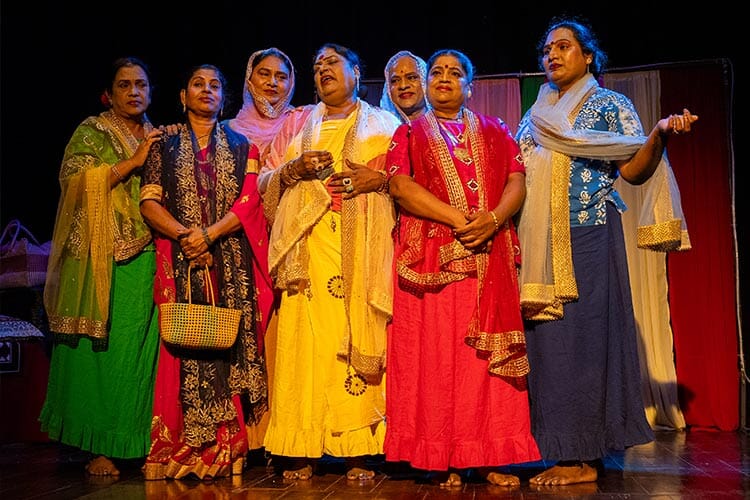
“In traditional families, the elders tell the story of the family lineage. Children know their roots,” says Srijith. “In our queer and trans family systems, it’s essential to tell these stories, too. Hearing the history of our community, and the stories of elders, help people feel that they still have roots.”
Srijith and his cast of performers see “Talki” as a critical piece of Payana’s larger movement for LGBTQI+ rights. The play is now performed in the shadow of India’s 2026 law severely restricting how the state identifies people’s gender. It’s hard to quantify the play’s impact—but the performance leaves an undeniable impression on the audience. And each person who opens their mind can ripple outwards.
“Queer acceptance starts in our families. And we dream of it expanding: if my parents can accept me, then maybe my neighbors can. And if my neighbors, then maybe all the houses on my street. And then everyone in my district, until this shift moves all of India,” says Revathi. “We know that love and acceptance can spread so, so far.”
View one of Payana’s performances of “Talki” by playing the video below: