
Thailand’s government has created an ambitious goal of achieving “net zero” carbon emissions throughout the country by 2050. This may sound like a commendable effort to reduce carbon emissions. However, the government considers carbon projects to be a key strategy towards this goal, claiming that they offset pollution and compensate for existing emissions. In fact, they are spearheading many carbon credit projects themselves, along with corporate partners.
AJWS grantee EnLaw has been studying the impact of forest-related carbon projects, particularly on Thailand’s Indigenous communities, over the past year. Six months ago, they also began studying three cases exploring alternatives to carbon projects, which is ongoing.
“Corporations are planting trees on public land to offset their greenhouse gas emissions, allowing them to continue to use fossil fuels, including gas, oil, and coal. That is not achieving net zero. It’s not a real solution to the climate crisis,” says Surin Onprom, a lead researcher at EnLaw. “We must turn to green energy such as wind and solar, and demand a transparent energy transition plan from the government.”
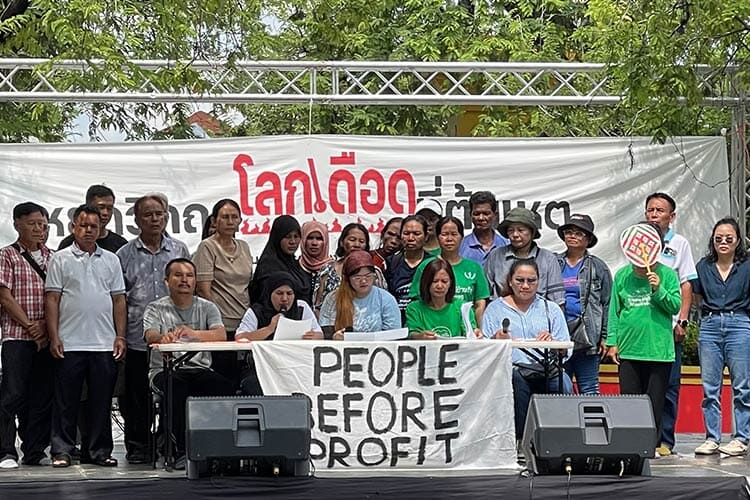
EnLaw advocates for and provides legal support to people and communities suffering from industrial pollution and its impacts. Their research has found that many communities agree to carbon projects without knowing the consequences in advance, because the project developers do not disclose them.
Too often, EnLaw says, communities initially view the projects as a positive, believing the projects will allow them to earn more income that they can use for conservation and community development. In the long-term, these projects weaken communities’ rights — as their land is utilized for carbon projects, communities lose access to their land and territories that they depend on.
Indigenous communities living in government-protected areas are uniquely vulnerable to carbon projects because, according to Thailand’s Community Forest Law, they are not eligible to register their territory as an official community forest, a move that would protect their land. Instead, the land they live on is controlled by the Thai government, who want to use this land for carbon projects as part of their “net zero” emissions plan. Indigenous people who depend on this land may see their ancestral home and resources seized from under them without their consent.
“We need to promote the active participation of local and ethnic communities in the development of green energy. Most of these carbon projects are being implemented by the private sector without the participation of local and ethnic communities, and some projects negatively affect their livelihood and are encroaching on and exploiting them,” Surin explains.
EnLaw’s three case studies are looking at local Indigenous communities across Thailand who have so far not opted into carbon projects: the ethnic Karen community of Baan Klang, who have had to shift away from their agricultural traditions due to government conservation policy and instead sell their natural resources for profit; Pred Nai, a coastal community who cultivates their mangrove forests and sell mud crabs for income; and Kham Paa Lai, who have been struggling to protect their land from carbon project developers due to their location within the National Reserved Forest boundary, which is managed by the government who seeks to rent the land to the private sector.
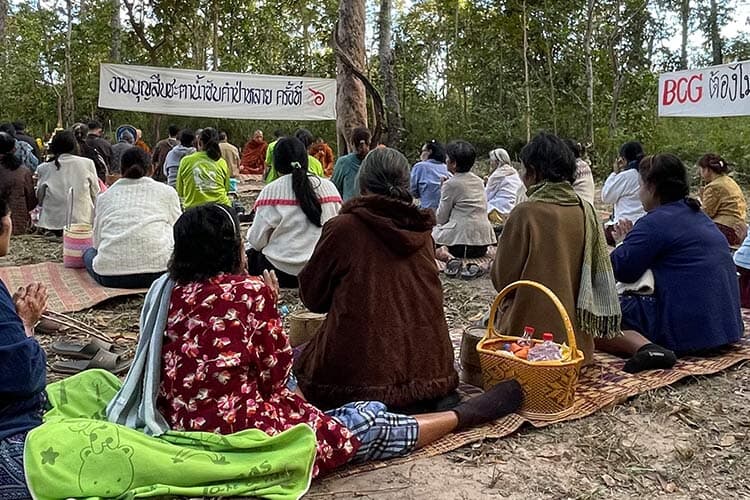
During the past six months, these three communities have been meeting regularly for group discussions around the impact of carbon markets and alternatives to this false solution. This research will inform EnLaw’s approach to legal advocacy going forward.
For now, the movement against carbon projects in Thailand is still building power. As these projects become more well-known across the country, the resistance against them will continue to grow.
“We need to go to the root of the problem, to stop using fossil fuels and transition to green energy. We are demanding climate justice. We need mechanisms to compensate communities who have been impacted — the accountability of the corporations who are involved,” Surin says. “In this movement, we are centering the principles of the UN’s Universal Declaration of Human Rights to support ethnic groups in Thailand, from the community level to the national and international level as well, and exposing this fake climate solution.”