
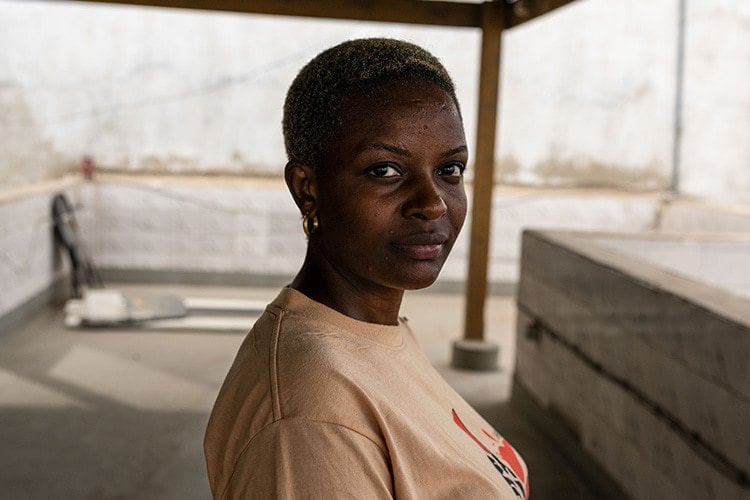
Rachel Butacha, 25, Democratic Republic of Congo
Rachel Butacha smiles when she explains that “my family name means ‘hope’ in my language. Even if someone is sick or upset, they can never abandon their ‘butacha.'”
Somehow, neither has she.
Today, Rachel lives at the KARIBU building in Dakar — the safe house for activists in exile, run by AJWS partner organization Y’en a Marre. Her journey to KARIBU was long and twisted, but it began with her decision to speak out against the violence and injustice she saw at home, in Goma, Democratic Republic of Congo. Goma is the epicenter of one of the world’s most violent conflicts, between Congolese military forces and rebel militias like Rwanda’s M23.
When she was 17, long before the current crisis, Rachel joined Filimbi — an AJWS partner organization speaking out against government corruption and repression. She quickly became a spokesperson for the organization; she was comfortable, confident, and steady, the result of a childhood spent singing.
“I felt like a voice of the voiceless, the citizen representing those who believed in peace. And so I spoke up, knowing my voice is powerful,” she says. “But we can all protect each other. ‘Filimbi’ means whistle in Swahili, and we distributed whistles across Goma. When you saw the rebel cars, you blow.”
In 2023, when the current violence erupted, Rachel was a well-known activist, frequently interviewed by local and international news outlets. This exposure proved dangerous.
“I realized I was putting my own family in danger,” she says. “My dad said, ‘I love you very much. You must follow your own path. But we can’t breathe — you need to leave.'”
She pauses in thought. “In Congo, you can be killed in an instant. Soldiers or rebels, it doesn’t matter. Death surrounded me in Goma.”
Rachel went into hiding, but refused to be silenced. As sexual violence spread, she launched a campaign through cellphone messaging apps encouraging women to carry condoms. Her recording was disseminated widely by activist groups.
“Rape is a weapon of war. Rebels may not kill us, but they can give us diseases. Rwanda has one of the world’s highest HIV rates. I encouraged women to ask the rebels: Please breathe, please use a condom,” she says.
In 2025, Rachel fled for her life — into Burundi, then Tanzania, and eventually boarded a plane to Senegal.
She calls her life at KARIBU “a transition of the soul.”
“When I landed in Dakar, two Y’en a Marre members greeted us, welcomed us. I was suspicious of every face. I was closed and distant. But I saw them and understood: I was safe,” she says. “My first weeks here, I couldn’t sleep. I keep hearing bullets whizzing by.”
Slowly, with careful support from Y’en a Marre staff and her KARIBU housemates, she has begun to breathe. And recently, she started to sing again — even performing at a Y’en a Marre event.
“I am healing from my wounds,” she says. “Today, I can spend a few hours, or even a few days, without closing my eyes and seeing war.”