My whole life, Haitians have demanded political representation. Now we need it more than ever.
As a child, my first perception of government was military uniforms, as Haiti went through repeated coups after the fall of the Duvalier dictatorship. In our neighborhood, government men beat people and stole things.
I did not yet understand that this predation was far from incidental—it was the direct consequence of a government that did not represent the people it ruled. Without representation, leaders are not accountable to the population and can exploit people and resources with impunity.
Much later, I came to see that the Haitian people had been excluded from governance, in every form the system has taken, for most of Haitian history. Through my own activism, I came to realize that today, true representation remains out of reach because the government is controlled by networks of officials, business leaders, and underworld figures bound by corruption and criminality.
The only way to build representation is to instate a credible transition government able to break up these networks, punish those who have committed crimes, and hold clean elections.
That is what we desperately need right now, as well as force to subdue the gangs. If we fail to stem criminality in government and replace our leaders, Haiti will remain weak, and the gangs will retain power.
For decades, the international community has treated Haiti’s problems as crises of security or humanitarian aid. But the real underlying crisis—the one no one ever truly addresses—is a crisis of representation.
The roots of exclusion
As a university student activist, I traveled the country and saw rural people living cut off from any say in governance or benefit from the state. No one spoke French, but the legal system worked in French. There were no public services, such as health centers, schoolteachers, or road repair. In places of great agricultural production, people had no support for storing or distributing the food.
I began to understand democracy as a way to structure a country so that programs, laws and policies reflect the people’s wants and needs.
But Haitians were not even choosing our own leaders. After the catastrophic earthquake of January 2010, despite massive displacement and destruction—many people didn’t have ID cards and many polling places were rubble—the international community pressed for elections. Only about 23 percent of those eligible voted that November.
Amid fraud allegations in the first round of voting, the U.S. and Organization of American States pressed Haiti to simply disqualify one candidate and boost another to the second round—and that candidate, the right-wing populist Michel Martelly, won. Haitians voted, but foreigners chose the victor.
That was a turning point. Martelly, who boasted of being a “legal bandit,” brought drug dealers, kidnappers, and gangsters to the presidential palace. His Parti Haïtien Tèt Kale soon stacked the civil service with cronies.
When leaders are not chosen by the people, they owe the people nothing—and they govern through coercion, not service.
Martelly’s handpicked successor, Jovenel Moïse, who had no experience of public office, helped consolidate power using gangs. Haitians could not do much to stop the enormous criminal machine taking shape within the state.
A movement for representation
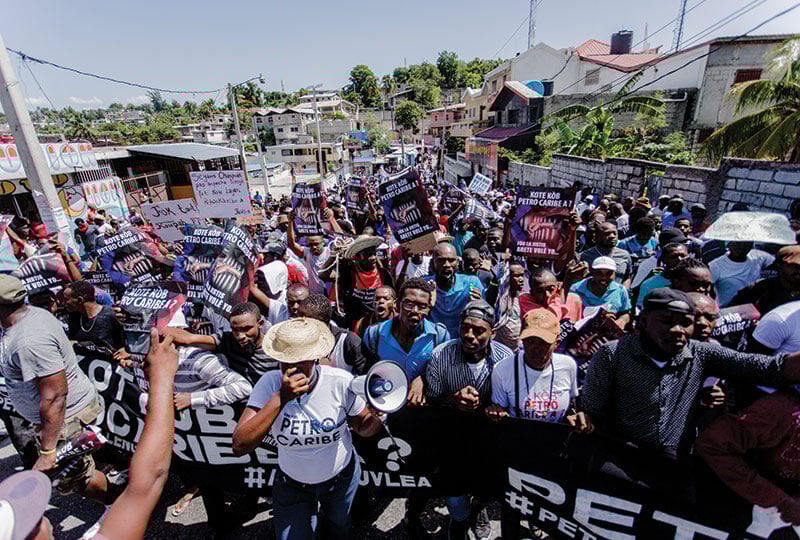
By summer 2018, young people filled the streets protesting corruption. Outrage over the government’s theft and squandering of the PetroCaribe aid fund became a national uprising.
In the fall, police started firing live ammunition at protesters—dozens of people died. Then in November, gang members collaborating with several top government officials massacred 71 residents of La Saline, a Port-au-Prince neighborhood helping to plan a large protest. We realized our government would rather kill us than be held accountable for its crimes.
Full of grief and fear, we protested for two nights outside the Superior Court of Accounts, shouting “Nou pap dòmi!” (“We won’t sleep!”), demanding the judges release their long-delayed PetroCaribe audit.
The audit revealed nearly $2 billion lost to phantom projects and political favors. Yet even when the president himself was implicated—and masses of people marched in the streets—nothing happened. There were no resignations, no arrests, and no trials.
That is when the movement shifted.
We called for the resignation of the president. Even as the country ground to a halt in a series of general strikes, or “peyi lok,” officials were not moved. It was clear that no one in power considered themselves accountable to us, the people.
Conceiving of a democratic process
In January 2021, several hundred civil society groups across the country gathered in a Port-au-Prince hotel to seek solutions for governance. It was astonishing to see such varied groups come together: peasant organizations and urban activists, churches and vodou practitioners, feminist and human rights groups. I joined a follow-up committee tasked with engaging Haitian civil society to devise a solution for our political and institutional crises.
Finding a solution began to seem particularly urgent as Moïse, who was ruling by decree after parliament had disbanded, announced he would stay an extra year in office. He fired three Supreme Court judges who opposed him and replaced them with his own illegal appointees.
As protests erupted throughout Haiti, we began to hammer out a process for Haitians to create a representative transition government that could rebuild institutions, reinspire trust, and mount credible elections. The goal was not simply redistributing power—but grounding our government in accountability to the people.
Could civil society help pave the way for a return to democracy?
A violent end for Moïse
In July, a team of assassins entered Moïse’s home and killed him in his own bedroom. We were shocked and deeply shaken.
Three Haitians began vying for the role of prime minister-cum-head-of-state: the then-interim prime minister; the head of the Senate; and Ariel Henry, whom Moïse had named prime minister but had not yet installed.
Meanwhile, there was new urgency surrounding a popular assembly planned by civil society to propose a transition government. Haiti’s situation was far outside anything the Constitution had anticipated—we had no president, no legitimate prime minister, and no legislature. Fraudulent, contested elections had destabilized the country, and brought criminal networks to political power. We needed a real transition: a government that could break with the past, purge the criminality within the state, and set up clean elections.
The day of the popular assembly, the U.S. embassy in Port-au-Prince broke the impasse by tweeting a statement of support for Henry from a core group of foreign ambassadors.
Again, the international community stepped in before Haitians could decide our own leaders.
A consensus proposal
Still, we unveiled our accord at the Hotel Montana on August 30. It was an extraordinary moment for Haitian civil society—at a time of violence, fear, and division, we had built broad consensus on a representative and inclusive path forward. The accord called for a two-year transition government, with neutral and credible civil society leaders, focused on rebuilding democratic institutions and restoring the state’s capacity to deliver justice. About 1,200 Haitian civil society leaders and organizations eventually signed on.
Again, we united to make a demand—and received no response at all from the government.
Negotiations with power
For many months, Ariel Henry refused to publicly acknowledge the Montana consensus or any need to negotiate with civil society. Later, he met with us after international policymakers suggested it.
But he treated us as upstart political rivals to be discredited, coopted, or brushed aside—not as representatives of a mass movement of Haitians with legitimate concerns that deserved focused attention.
I talked with Henry in Jamaica at a 2023 meeting Caricom organized with Haitian civil society and political leaders. Henry said he would not step down as prime minister, or accept civil society’s proposal for an interim president or advisory council to govern with him. “I’m not going to let the country fall into chaos,” he said. I answered, “You should have an open ear to what the population wants.” When I told Henry that neither the Constitution nor the people considered him legitimate, he stood up and left the room.
I considered Caricom’s approach during these sessions deeply flawed—it did not reflect a real understanding of the dynamics among Haitian actors. Caricom officials offered all the Haitian groups equal say—including decades-old political parties deeply rooted in Haitian society, brand-new political parties with no popular base, and our broad coalition including more than a thousand civil society leaders and groups. I made the personal decision to sit out further internationally brokered talks.
Henry was ousted in March 2024 when gangs took over the Port-au-Prince airport and blocked his return from a trip abroad, and the U.S. suggested it was time for him to step down. The Dominican Republic refused to allow his plane to land on Dominican territory to permit his return. Once again, outsiders decided Haiti’s leadership.
I did not participate in the talks brokered by Caricom for the current transition government. They produced a presidential council dominated by the very political parties and interest groups that had contributed to the criminal degeneration of the Haitian state.
They co-opted a few token pieces of the Montana process—for instance, the idea of a civil society role in the government.
But the Montana process was never about installing particular people in power—rather, it was about restoring the system’s functionality so the people could freely choose their leaders.
This transition failed
Unsurprisingly, the current transition government, hampered by infighting and corruption scandals, has achieved none of its goals. It has not reduced gang violence, fixed the broken state, or prepared for elections. Officials at every level behave like the administrations before them—competing to extract resources from the state.
Haitian business elites are part of the problem. The same business leaders who fund campaigns also buy contracts, port use, and customs passage. Interconnected corruption networks provide this system with remarkable resilience, keeping the same people in political power. Young Haitians see politics not as service, but as a system of criminal exchange.
A path to stability requires popular participation
If all this persists, criminality will remain embedded in our government and society, and we will continue our descent into hell.
Elections cannot be credible if they are organized by officials motivated by self-preservation and linked to criminal networks. And any lasting peace depends on credible elections and a sense that people are represented.
Representation is not symbolic—it’s functional. When leaders are accountable to their people, they are motivated to reduce violence, build institutions, and invest in services, instead of patronage.
Now, the only way out of Haiti’s crisis is an inclusive, civil society-led transition government that targets criminality in political and public spaces. That is what the U.S. and international community should support.
An effective transition is the clearest way to break with the criminal past. Only when criminality is extracted from government can elections be independent. Only then can Haitians finally freely choose our own leaders. Only then can we begin to build the country we want to live in.
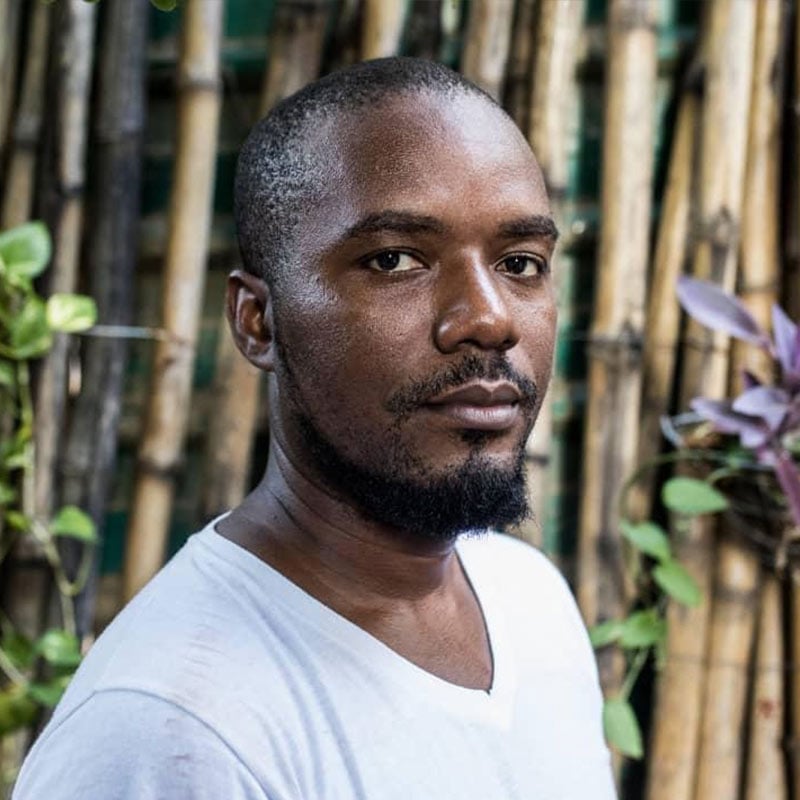 James Beltis is a leader of Nou Pap Dòmi and contributed to the development of the Montana Accord for a representative government. (Photo by Valérie Baeriswyl)