
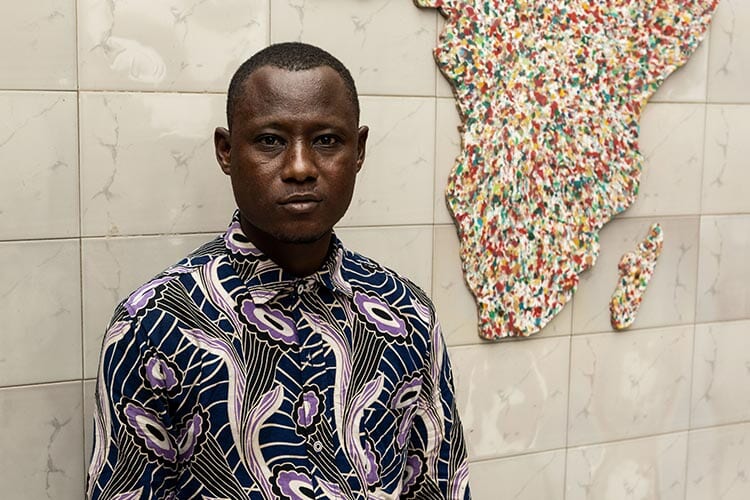
Mohamad Cisse, 35, Guinea Conakry
“Since independence from France, my country has only known dictatorships — we have never truly known freedom,” says Mohamad Cisse about his home, West Africa’s Guinea-Conakry.
Growing up in a middle-class family with eight other siblings, Mohamad finished university and became an engineer. But he saw how the high cost of living — and complete lack of workers’ rights — created an impossible situation for working class Guineans. While still a student, he joined labor movements in solidarity with unions, but witnessed in horror as peaceful demonstrators would be murdered by police and military forces.
His will to fight for change crystalized.
“Human rights aren’t just words written in a document. They are qualities we are born with, fundamental to each of our lives. I am a human, and so I have rights. These rights may be trampled, violated or ignored. But they still exist,” he says today. “And no government, no military junta can take them away from us.”
In 2024, Mohamad was leading a grassroots organization speaking out against workplace injustice and living costs. They met at night, in secret. But one evening, their meeting was raided by military forces; Mohamad was bound, gagged, and brought to the presidential palace, where he was interrogated — before being transported to a remote prison. There, he was brutally tortured, physically and psychologically.
“They demanded to know how we planned to topple the regime. But all I could answer was the truth: We’re activists fighting for a better life. We’re not planning a coup,” he says. “I had no idea if it was day or night. The violence was nonstop. I truly didn’t believe I was going to survive.”
Miraculously, Mohamad was released — transported from the prison and left in a gutter. He was unable to walk; he remembers crawling until people spotted him and brought him to a hospital. Within days, the government had released a statement denying any connection to the kidnapping. Mohamad knew he needed to leave — for his own safety, and that of his family.
He connected with Y’en a Marre; KARIBU had just opened its doors. He fled Guinea-Conakry, and found a new home — a safe space — at the KARIBU house.
“KARIBU has been a lifeline for me. My comrades here, we’ve all survived violence, imprisonment, persecution, brutality — simply for believing that all people deserve human rights,” he says. “I’ll never give up that belief, and I’ll never give up my fight. But I’ve got to do it from afar.”
Today, Mohamad is integrating into the Y’en a Marre movement, and he’s working in Dakar. He dreams of returning home one day — to a just, safe, and peaceful Guinea Conakry.