
Kenya’s government has been selling off Indigenous communities’ ancestral lands to foreign companies for carbon projects without their free, prior, and informed consent, leading to the forced eviction and displacement of communities such as the Sengwer and Ogiek peoples.
But AJWS partners East Africa Women-Led Indigenous Assembly (EAWIA) and Sengwer Indigenous Community Trust (SICT) are educating and organizing affected forest Indigenous communities to fight back. In particular, they are empowering Indigenous women and girls who are both impacted and sidelined by carbon projects to be part of the solution.
“Greenwashing is active in Kenya, mostly around Indigenous people’s lands. It is dangerous because of the disempowerment, marginalization, and the state’s dangerous lack of transparency,” says Gitahi Githuku, AJWS Program Officer based in Kenya. “There is no access to information about these companies [that are investing in carbon credit projects].”
If these companies meant well, Gitahi explains, they’d openly share information and engage with Indigenous people as real landowners. But instead, “there is a pretense that there are no people living in this land or an even more dangerous narrative that the Indigenous communities living on the land are ‘destroying the forest.’ The women who actually work on this land are not being seen — and are losing everything.”
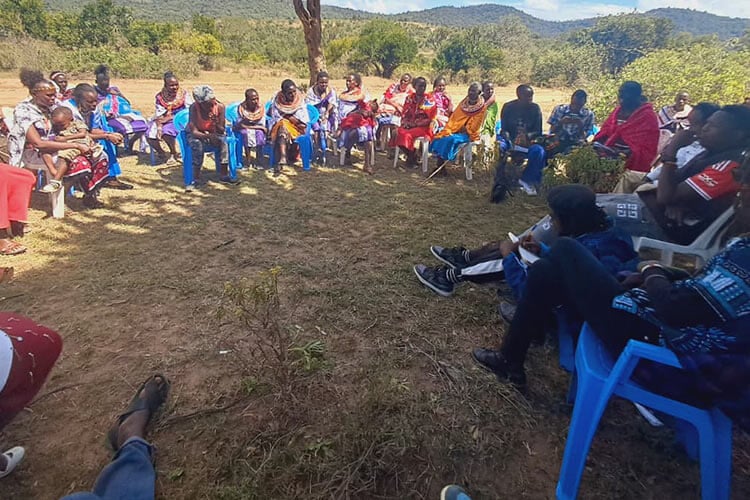
Kenya’s government promotes these carbon projects because they bring large sums of investment into the country from corporations in wealthy, industrialized countries, who benefit from greenwashing by appearing to be taking action against climate change.
By championing and paving the way for carbon offset projects, the Kenyan government is promoting economic development strategies that come at the expense of its own people and their lands. When the government evicts Indigenous communities from their land, these communities are often forced into livelihood activities which cause harm to the environment, such as charcoal burning or farming unsustainably. Additionally, women and girls seeking refuge from evictions often suffer the most, as they may end up in other people’s homes with no guarantee of safety.
“Any money that comes in, whether clean or dirty money, ends up in the pockets of the powerful. So the government wouldn’t mind bringing in as much as they can because it is going to benefit them and their self-interests,” says Teresa Chemosop, coordinator at EAWIA. “We are not getting solutions for pollution. We are not getting solutions for the problems which industrialized countries are causing. Instead, we are just helping them. Instead of asking, ‘How do we reduce emissions? How do we save the environment?’ We are asking, ‘How do we cover for these people?'”
Climate justice activists and movements urge governments to learn from Indigenous communities about how to protect the environment, as these communities have been a model for the sustainable stewarding of land and forests for generations. By conserving their forests, these communities have been playing a critical, albeit often overlooked role, in mitigating the climate crisis.
“When you remove the Indigenous lands from Indigenous people, you are taking away the indigeneity. The Indigenous lands and forest and Indigenous people, they are synonymous — if you remove one from the other, you are destroying them,” says Gitahi. “Indigenous people have a wealth of knowledge that they have used for generations with proven solutions. Their knowledge should be adapted and amplified as a sustainable solution to climate change.”